

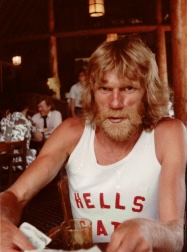
An excerpt from Chapter 4, A Few Thousand Miles, from In Search of Al Howie by Jared Beasley. Al Howie was one of the world’s first ultrarunners, taking on insane thousand-mile runs in split shorts and tank tops, fueled by beer and his own personal demons.
“He stays in his room, mostly.” The nurse had a kind voice but seemed nervous about what she could and couldn’t say. “He has his own ways, doesn’t like to be told what to do, but everyone likes him.” She seemed affectionate when she spoke of him. The oddest bit was that Al Howie was standing right beside her.
I found him late that summer in 2014 in a care home in Duncan, British Columbia. He waited while the nurse spoke over the phone since he didn’t have a phone in his own room. Eventually, she handed me over to him. The voice that came over the phone was thin and raspy with a thick Scottish brogue.
“First, I just want to say that you are a fantastic runner.” No response, just a faint grunt. An awkward pause, and my hands began to sweat. I brought up my neighbor Emile.
“A good runner,” Howie said, but made odd, grunting sounds as if he was struggling to breathe. Air came in sporadic gulps like someone on the verge of hyperventilating.
“Well, he wants to speak with you. Not now,” I said, “but he’d like me to connect you with him.”
“No,” Howie blurted, quickly. “I’m not ready.” Another pause.
I wondered how I was going to complete my mission of getting Emile in touch with his old friend if Howie wouldn’t allow it. I didn’t want to betray the man’s trust. In his condition, it was obvious that it took some courage just to speak with me.
“Do you still run?” I asked.
No answer, just heavy breathing. “Call back next Wednesday,” he said, and the nurse was back on, more upbeat, almost joyous. “That’s more than he usually says.”
“How long has he been in the care of the state?”
“Oh, about, well, over 15 years.”
I had two different versions of why Al Howie was under Canadian institutional care. One was that he had an unusual case of diabetes. The other was from his ex-wife Claudia, who only hinted at something altogether different. “He’s not there for the reasons they say.”
I repeated the call ritual the following week, and he opened up a bit more. But he would only talk about running. If you didn’t distract him with questions about his personal life, he could spit out stats like a savant, as if he’d been saving them up for years.
“I first ran with Emile in ’84.” His mind was suddenly as sharp as a dart, remembering a Sri Chinmoy 24-hour run. “I did 137 miles that year. My best was 150.” He went into a storm of numbers and years, one after another. Then, just as quickly as his mind opened, it seemed to go dark.
“What kind of warm-ups did you do?”
The grunts came back for a moment.
“None,” he said, finally. “Waste of energy.”
“What did you supplement with on your runs?”
“Beer.”
“Beer?”
“Everybody was stretching and jogging in place. I was there knocking back a pint. Loved the look on their faces when they saw me standing on top of the podium.”
“Drugs?”
“They make a good time better.”
“Has anyone ever written your story?”
“No.”
“Do you want someone to?”
“Yes.”
“Do you want me to?”
“Yes.”
“Just to be clear…”
“Yes.”
“Okay, where should we start?”
“1991, the run across Canada. East to West.”
The Tomorrow Run: 4,533 Miles Across Canada
Besides the 5,290 miles he’d run in ultramarathons between 1989 and 1993, he’d also run 4,533 miles across the length of Canada— recorded, documented—a world record of 63 miles a day for 72 days. It was called the Tomorrow Run.
“What do you want people to know?” I asked.
He paused. “The whole truth.” Then a thud as the phone hit the table.
So, the following Wednesday, we’d pick up there…
In the meantime, I found a woman with a striking memory of the summer of 1973—of the bonfires on the beaches of Ierapetra, on the eastern coast of Crete—and of meeting a long-haired, slightly feminine man in a smoky tavern called Poppa’s. He sat by himself in a corner, penning away at a short story. He dreamed of becoming a novelist, he said, though she could see he was clearly drunk—eyes glazed, full of a hope and wonder tugged down by some inner sadness.
When she found him two weeks later, sitting on a wall of the boardwalk by the beach, a small boy was with him, about four. The two frowned shyly as she approached. Gone was the dreamlike reverie in Howie’s eyes. In its place was a sheepish, almost childlike hesitation. He asked her if she could spare a few dollars.

Explore In Search of Al Howie
Al Howie was one of the world’s first ultrarunners, taking on insane thousand-mile runs in split shorts and tank tops, fueled by beer and his own personal demons.
Then he disappeared amidst a swirl of kidnapping allegations and an Interpol investigation.
In Search of Al Howie is the critically acclaimed story of a man who ran forever and how author Jared Beasley found him—uncovering the origins of ultramarathon and exploring the larger-than-life personalities who carry on the legacy.