


Excerpt from Chapter 3: Why You Suck at Pacing from How to Run the Perfect Race: Better Racing Through Better Pacing, by Matt Fitzgerald
In July 2020, fitness device manufacturer Garmin fell victim to a ransomware attack that completely shut down the company’s online services for several days. Runners and other athletes who relied on these services for uploading and downloading workout data had to make do without them during this period. A disconcertingly large number of the affected athletes responded to the disruption by completely freaking out, many publicly. A Garmin user myself, I did not freak out, but I did appreciate the panic I observed on social media as a reminder of how dependent runners have become on their fitness devices.
Not that I needed reminding. As a coach, I see daily evidence of the stymieing effect sports watches are having on pacing skill development. Here are a few examples of device overdependence I’ve collected from athletes I’ve worked with. Not all of them are specific to pacing, but each is representative of a general relationship between athlete and device that holds the athlete back from achieving pacing mastery.
Anything for the Score
Icy roads forced Sergio to go slower than normal in the run he’d downloaded to his device from an 80/20 training plan. As he neared the end of the run, Sergio glanced at his watch and discovered that, because of the slow pace, he was not going to achieve the predicted Training Stress Score (TSS, a proprietary metric that factors together workout intensity and duration). To avoid this perceived failure, Sergio extended the run by several minutes, stopping only when the forecasted TSS had been reached, believing that in so doing, he had salvaged the original intention of the run. The problem with this logic was that it assumed Sergio’s slower-than-normal pace indicated a lower-than-normal intensity when in fact the extra muscle work needed to remain upright made the effort harder, as he could plainly feel. By extending the run, Sergio made it harder still—all because he trusted an esoteric mathematical projection more than he trusted his own perceptions or common sense.
Servant to the Segment
Ryan, a mountain runner I coached for a couple of years, ran the first part of a long, uphill tempo effort much faster than he was supposed to, and he soon paid the price, practically crawling to the summit. When I asked him during our next weekly call what the hell had gotten into him, Ryan admitted that the first part of the climb was a Strava segment he wanted to capture. “Forgive me,” I said, my voice dripping with sarcasm, “I didn’t realize Strava was coaching you now.”
Data or It Didn’t Happen
While vacationing in the Napa Valley with my wife one summer, I received an unexpected call from Bob, a triathlete I coached. The few such calls I’d gotten from Bob previously had brought bad news, so I was braced for another injury report when I answered. I needn’t have worried. Evidently, Bob’s power meter had died at the beginning of a bike ride, and he was now standing at the side of the road, wondering if he should go ahead and complete the workout sans data or push it back a day and try to get the device fixed in the meantime. Hearing this, I couldn’t decide whether to laugh or cry. In what possible universe could a dead power meter be considered a reason to miss a workout?

Virtual Reality Takes Over
Amir completed a set of speed intervals on his indoor bike. Minutes later, my phone notified me that the workout had been uploaded. When I analyzed the data, I saw a massive spike in power at the start of each interval before Amir settled back into the correct wattage zone. Knowing the answer, I asked Amir what was behind those crazy spikes. Can you guess? Bingo! Noticing a lag between the time he started each interval and the time his bike’s power meter caught up with the change in output, Amir had pedaled like mad in the first few seconds in a desperate effort to produce the desired number, then slowed down on discovering he’d overshot the target—not once but 12 times in a row. Amir’s a smart guy. On some level, he knew his power meter was lying to him, giving him yesterday’s news, so to speak. Yet he acted as though he believed the number on the computer was more real than what his body was doing.
My Heart Rate Monitor Says I’m Dying!
Kevin posted a concern about his recent training on an online forum that I moderate. Lately, he explained, his heart rate had been a little higher than normal in relation to his pace, and the VO2max estimates his watch fed him after each run had dipped slightly. A newer runner, Kevin was becoming discouraged and beginning to doubt the effectiveness of the 80/20 method he was following. Having seen this movie before, I asked him how he actually felt while running and whether he would notice anything different if he ran without his watch. “Now that you ask,” he replied, “I think I feel fine while running, maybe even good, but when my pace is right and my heart rate seems high, I feel down about it and frustrated during my run and also after.” It was just as I had suspected: Kevin’s supposed crisis of fitness was in fact a matter of perception, an emotional panic triggered by information that had various possible explanations, all of them more plausible than the one Kevin had assumed in defiance of how he was actually feeling and performing.
Happy After the Fact
Suzanne was crestfallen at the end of her tempo run, having fallen short of the pace targets I’d given her. But later, when she reviewed her power data, Suzanne saw that, according to this other metric, she’d actually performed better than her device’s estimation of her current fitness level. Windy conditions, I concluded, were the cause of the discrepancy between Suzanne’s pace and power numbers. In any case, she was no longer disappointed. Mind you, nothing had changed about the run itself.
I could give you many more examples, but I trust I’ve made my point, which is that device overdependence is extremely pervasive among runners and manifests in myriad ways. Despite superficial differences, these several examples have one thing in common, which is a certain tension between what the runner’s body and mind are saying and what the runner’s device is saying. In matters of pacing, this tension takes the form of a disagreement between what feels right to the runner and the runner’s interpretation of device data. Each such disagreement must be resolved one way or the other. It’s a matter of who gets the final say, the runner or the device. Runners who are comfortable overruling their devices are not overdependent and have a clear runway toward pacing mastery. Runners who are not comfortable overruling their device are overdependent and must gain the upper hand in their relationship with their device to become a pacing master.
Running devices aren’t bad. They just aren’t as capable of guiding runners to their limit as runners themselves are. That’s because (as I mentioned in the preceding chapter) a runner’s performance limit is not determined by anything a wearable device can measure. It is determined by subjective perceptions. If a runner lacks sufficient confidence in their feel for pacing and can’t grant it the deciding vote in all pacing decisions, pacing mastery will elude the runner, at least for now.
It doesn’t stop there, however. Running devices also rob runners of existing pacing ability through a phenomenon called cognitive offloading. Technologies such as running devices become extensions of the brain. We use them to offload cognitive tasks from our brains to external gadgets. The problem is that when the brain stops performing a certain task that has been assumed by a gadget, the brain gets lazy and loses the ability to perform the task for itself. For example, research has shown that habitual reliance on GPS technology for navigation causes spatial memory to deteriorate and leads to measurable atrophy in the hippocampus, a part of the brain that’s heavily involved in helping us find our way around. Running devices do something similar with respect to pacing skill. The more we lean on them in our pacing decisions, the worse we get at reading our perception of effort; measuring time, distance, and velocity by feel; and knowing our limit.
Too big to ignore, the problem of device overdependence has gotten the attention of scientists. In 2020, the journal Psychology published a study led by Pierluigi Diotaiuti of the University of Cassino and Southern Lazio in Italy. A group of 111 runners supplied information about their use of “sports trackers” and completed a questionnaire designed to assess device dependency, which was scored on the basis of how subjects answered questions such as, “If you could not have your device with you, would you still train?” The results indicated that most runners start off relying too much on their devices. While some worked their way past their overdependence, others didn’t.
In particular, runners who managed to escape device dependency tended to pass through clear stages in their use of sports trackers. The first stage was one of exploration and discovery—learning what their device could do, essentially. From there, runners moved into a consolidation phase, characterized by a more focused and purposeful use of key features. Then came the paring phase, marked by a rigorous selection of features that left runners attending only to data they deemed essential to goal achievement. The authors concluded that “more experienced runners . . . have shown that over time they have acquired a progressive mastery and internal control of their performance functions,” and they were able to use “the sport trackers in a strictly instrumental way, for which there was no perception of dependence or submission.”
Like I said, it’s all about who has the final say, the runner or the watch. Runners who aren’t comfortable overruling their device lack agency in their training, whereas those who get to the point where they trust themselves more than their watch gain a firm hand on the tiller of their running experience. Although this study did not look at specific consequences of device overdependence, I would bet my life savings that, as a group, the runners in this study who were least dependent were the best pacers.
A second noteworthy study on training device usage by runners was performed by scientists at the University of Twente and published in the journal Sensors in 2021. Through a combination of interviews and diaries, 22 competitive recreational runners provided detailed information about how and why they used their training devices. A number of these runners had interesting things to say about the tension they experienced between their own opinions and those of their device concerning pacing matters. Their natural inclination was to turn over control to their device and run on autopilot, as it were. But what they discovered was that their gadgets weren’t all that trustworthy in the area of pacing. To the extent they had offloaded pacing responsibility to their devices, however, the runners didn’t trust themselves either, leaving them in an untenable, rudderless state. Some resolved the dilemma by tuning out their device data altogether.
“I feel horrible when seeing that I am not keeping up with a pace that I planned,” one runner said, “so I start thinking if I should push myself harder on the next kilometer or punish myself by running slow. . . . I just avoid looking at it at all and check once I’m done because it influences me in the wrong way. . . . It’s just not that helpful, is it?” You couldn’t ask for a better description of what it feels like when you just can’t figure out how to transform running devices from a crutch, which is what they start off as for most runners, into the tool they must become for pacing mastery to be achieved.
Experience alone does not guarantee that a runner will eventually get to the point where they trust themselves more than their device. Not all of the experienced runners included in the Pierluigi Diotaiuti study described earlier escaped device overdependence. For that matter, most of the examples of device overdependence I shared above involved experienced athletes. Why do some runners escape device overdependence and master pacing while others struggle? What do they have that the rest lack?
In a word, self-regulation. A hot topic in the fields of sports psychology and general psychology, self-regulation is a general capacity, shared by all living organisms, to manage their internal states and behaviors according to the demands of a situation, and it is critical to pacing skill. As we will see in the next chapter, runners must either have or acquire a strong capacity to self-regulate to learn from experience and overcome device overdependence and the inherent difficulty of pacing to find their limit and run with confidence and control.
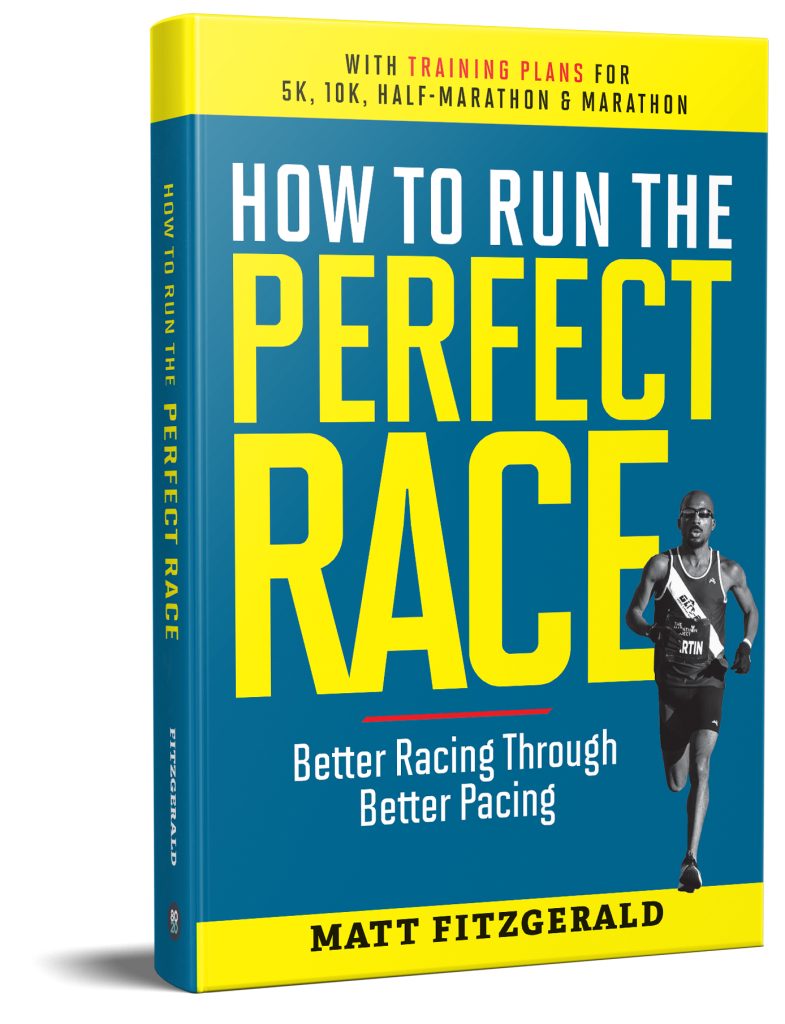
Explore How to Run The Perfect Race
In How to Run the Perfect Race, acclaimed running coach Matt Fitzgerald reveals how conventional training and device overdependence keep runners from accessing the full power of pacing.