


After suffering four years of the crippling effects of long COVID, lifelong runner Matt Fitzgerald is desperate to reclaim his life. Hell-bent on finishing one last race, Matt enters the Javelina Jundred, a 100-km ultramarathon. It’s a race that could just as easily kill him as provide his redemption from disease. In this excerpt from his epic memoir, Dying to Run, Fitzgerald shares how he wielded Stoicism to steel his mind for the Javelina Jundred ultramarathon.
The trail turns sandy, and my shoes begin to slip when I toe off the ground—not a lot, but enough to annoy me. All runners have their pet peeves, and loose footing is mine. That and wind. Not hills, though. I’m fine with hills because they’re honest. You see the top when you’re at the bottom and you know what’s coming. But wind and loose footing act invisibly, making it harder to run in a way that’s difficult for me to accept, like a balloon you can’t inflate because it has a tiny leak. There’s nothing less rational than getting angry at an inanimate object, but who among us hasn’t cursed a GPS navigator that sent us in the wrong direction? Many times I’ve wanted to punch the gusting air I was running through and kick the shifting ground I was running on, furious at these things.
Lately, though, I’ve been trying to cultivate a mindset of nonattachment with respect to loose footing and wind and other run spoilers. A runner who’s annoyed reflexively when they encounter pet peeves is an emotional puppet, twitching automatically whenever a string is pulled. The Stoics frowned on such dependencies, urging their followers to cut the strings and move freely. In his Meditations, Marcus Aurelius used this very metaphor, writing, “It’s time you realized you have something in you more powerful and miraculous than the things that affect you and make you dance like a puppet.”
My long COVID symptoms are like loose footing and headwinds that continue for days or weeks. Keeping sane these last four years has required that I snip the cord between mind and body so my mind doesn’t always jerk toward annoyance when tugged by bodily discomfort. I’m still a long way from full Stoic nonattachment, but when I started running again this year, I could tell I’d changed, and was now less of a puppet and more of a real boy, like Pinocchio.
I noticed it first at a place called Woody Mountain Road, a rugged dirt road near Dream Run Camp that I got to know intimately when I trained with the pros seven years ago. The thing I never liked about Woody was its washboard surface, which forced me to keep my eyes on the ground at all times, lest I catch a rut and sprain an ankle. I’d always take the smoothest way possible, weaving from one side to the other in search of the path of least annoyance.
I could easily have avoided Woody Mountain Road in my recent training for the Javelina Jundred, but it is close by and it’s actually a great place to run apart from the washboard factor. But most of all, my attitude was different. And so, with Mr. Aurelius in mind, I forsook my preferred Flagstaff running venues one Sunday and visited old Woody for a 12-miler, running all 12 miles with my eyes up, accepting whatever the ground gave me—and I did not sprain an ankle.
At Dream Run Camp we often start our afternoon gathering with a round of “wins and challenges,” where each person shares a win and a challenge from the last 24 hours. Eli disapproves of this exercise because he doesn’t like to label his experiences. To divide the day into good parts and hard parts, he argues, is to reject half of life, and the Stoics back him up here. In his Letters Seneca writes, “There is nothing either good or bad but thinking makes it so.”
On his second visit to Camp, Eli requested permission to lead our next gathering. A part of me feared that Eli would show up naked (he’s known for running almost naked) or do something else outlandish that would cause me to regret my decision to grant his request, but the rest of me couldn’t wait to see what Mr. “I am a human being” had in store for us. When the moment arrived, Eli pulled out his phone and read a brief personal essay he’d written about the prior morning’s group run in the Kaibab Forest just west of us.
“My morning run was meant to be free from any schedules and agendas,” he began in a priestly alto. “It was rather an inner calling to release the energy that my body had accumulated through the restful night. I ran with the intent to renounce attachment to any outcome of my labor, careful not to let thoughts of success or failure weigh on the quality of the effort.”
Pausing, Eli looked up to read the room. We were spellbound. He went on to describe a dual assault on his bliss by egoistic intrusions, which he deftly parried by falling back on his spiritual training.
“Engrossed in the growing sense of a renewed union with the source of my creation,” he declaimed, “the bright profundity of this experience shone through the depths of my being. A child of nature, a child of this life, immersed in the discipline of purification through the practice of running, I was in direct and living contact with the Divine.”
Eli takes a fair amount of ribbing from his fellow Dream Runners on account of his nonconformity, but not that day. He’s told me he wants to write a yoga book for runners, and I’ve told him he should. I know a lot of runners who could use a good dose of yogic thinking, including my younger self. But the Stoic path I’m on has led me in more or less the same direction as Eli’s yogic journey, knocking down artificial partitions between “good run” and “bad run,” “win” and “challenge,” and allowing the contents of these mind-made categories to blend together.
Detaching one’s mood from one’s circumstances is not the work of a day. But if you believe in your heart that Seneca was right, and if you make a good-faith effort to apply his wisdom, you will at least make snail-like progress in the direction of emancipation from realities you don’t control—or so I’ve found.

At the tail end of May—just over a week before the Lost Period—I biffed a speed workout I’d been looking forward to all week, falling well short of my target times and skipping the last rep. Afterward the Dream Runners were full of sympathy. “Man, that sucks,” said Kim, our first Alaskan.
“Not really,” I countered, channeling my inner Marcus Aurelius. “It’s just information. I’m not where I thought I was, and it’s helpful to know that.”
Those three words—“It’s just information”—have since become a comedic refrain at Dream Run Camp. Whenever someone has a terrible run, “It’s just information,” and everyone laughs. But the psychology behind it is no joke. Insofar as I’m able to recast negative elements of my running experience as information, they don’t bother me as much.
Ideas are powerful. Studies have shown that people who believe in heaven are happier than people who don’t, while people who believe in hell are less happy. Whether heaven or hell actually exists is immaterial; what matters is the belief. It’s hard to just make yourself believe something, however. Life experience must create the need to believe, tilling the soil of the mind to allow the seed of a certain idea to take root. In my case, getting sick allowed Stoic ideas to take root in a way that running never did.
There was more at stake, after all. It’s one thing for loose footing or high winds to spoil a run, another thing for disease to spoil your life. As annoying as headwinds can be, the run will be done in an hour or two regardless, and it’s only wind, so why not just be annoyed? But with long COVID my biggest annoyance is paralyzing malaise, a worse-than-death experience that has made me very receptive to the words of Epictetus, who rose from slavery to the highest ranks of Hellenistic philosophy: “Sickness is a problem for the body, not the mind—unless the mind decides that it is a problem . . . Say this to yourself whatever the circumstance and you will find without fail that the problem pertains to something else, not to you.”
My mind can be okay when my body is not. This is the belief I grabbed hold of when I found my bearings as a member of the Always Tired Club. I’d be lying if I told you it turned my sickest days into my happiest days (ideas aren’t that powerful), but my sickest days were happier for it, and I’ve put the same belief to good use in my return to running.
True believers act on their beliefs. A person who nods along in church on Sunday and growls “Get a job” at a panhandler on Monday doesn’t really believe what Jesus taught about how to treat the poor. (“When you give a banquet, invite the poor, the crippled, the lame, the blind.”) Likewise, a runner who claims to believe in the possibility and benefits of detaching their physical state from their mental state but then goes out of their way to avoid loose footing and wind, or whatever their pet peeves happen to be, is exposed as a hypocrite by the runner who makes the same claim and faces their bugaboos.
In an effort not to be a hypocrite, I made a point of doing my last big training run before Javelina on the most annoying route available, an unpaved forest service road with even worse footing than Woody Mountain and more exposed, with whipping winds coming straight at me for the first eight miles. Far greater than the physical challenge imposed by these conditions was the mental challenge of suppressing my annoyance and enjoying the run despite it. Yet aside from a few times when I lost focus and reverted to my true nature, I did enjoy the run. It’s amazing what our minds can do when we cut the strings and move freely.
Yet here I am less than half an hour into an all-day run and already I’m allowing myself to be annoyed by loose footing. I’ve prepared for these moments, however, and I know what to do: I think of that old yarn about two friends being chased by a bear, which ends with one friend telling the other, “I don’t have to outrun the bear— I just have to outrun you!” The bear in my situation is annoyance, and my friend is the runners around me. To gain an advantage over the competition, I don’t have to outrun the bear by remaining 100 percent unannoyed; I just need to outrun my friend by being less annoyed than these other runners. Like the guy in front of me, tall with a loping gait and a Hawaiian shirt. I watch him intently, like a telekinetic puppeteer, pulling mental strings to imagine him grumbling about the trail’s poor traction as if he paid extra for packed dirt and got this instead and now wants his money back. When I pass him, I’m no longer thinking about what’s under me.
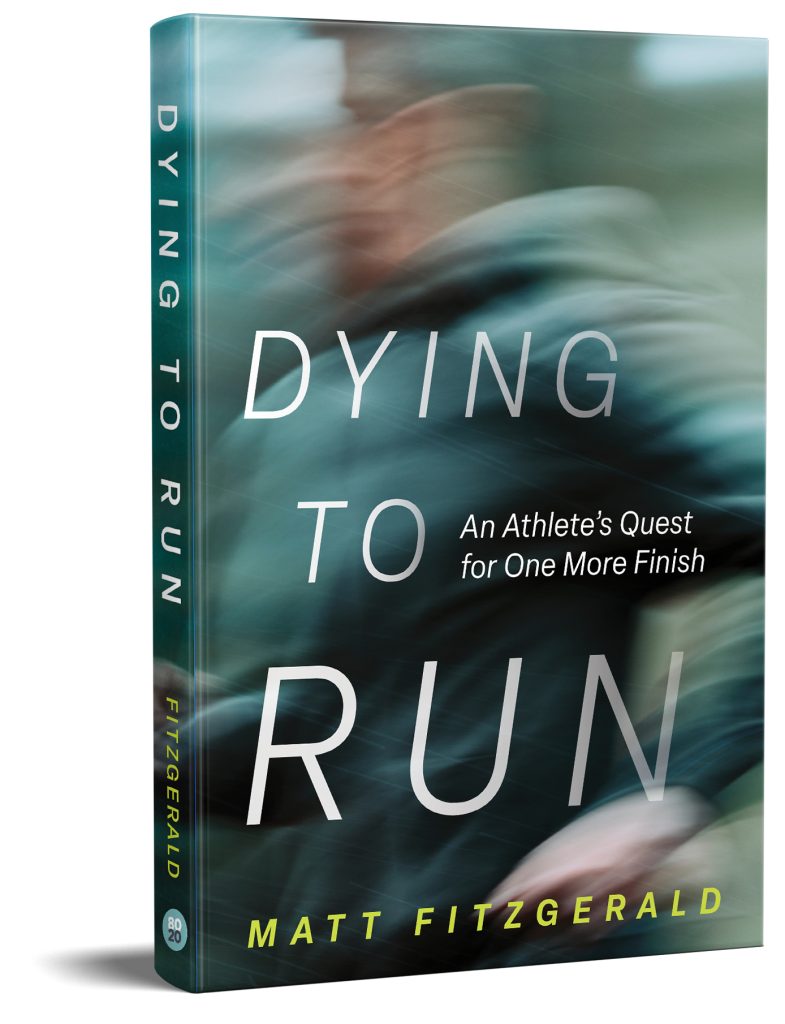
Matt Fitzgerald is Dying to Run.
What if you could race just one more time?
After four crippling years suffering from the mysterious effects of long COVID, Matt Fitzgerald is desperate to resurrect his lifelong passion for running by entering one more race, the Javelina Jundred, a 100-kilometer ultramarathon in the Sonoran Desert.
It’s a race that could kill him, but that’s a risk he’ll take to reclaim his life.
Dying to Run is a gritty race report, an epic story of adversity, and a look inside one man’s battle to live in the moment.