


In his new book, One Day Better, acclaimed mental performance coach Jeff Troesch shares sports psychology concepts he gained over 35 years of coaching professional athletes in the world’s most popular and high-pressure sports including the NFL, MLB, NBA, NHL, MLS, golf, tennis, triathlon, and NCAA collegiate sports programs. In this excerpt below, Troesch explores one method pro athletes use to stay focused.
One of the challenges in mental training is to keep your attention on the most productive thing at the most productive time. Most great athletes get their minds, or their internal environments, to be in a consistent place by building routines or rituals that prepare a place for them to basically park their attention when it might be prone to wander. They establish a consistent place to go to in between points, in between shots, or in between pitches in a micro sense—or in between games, in between matches, or in between competitions in a macro sense.
There’s some comfort for athletes in knowing where they can bring themselves back to if they find themselves in a mind space that is nonproductive or unhelpful. Most great athletes have routines that help them develop a consistent internal environment, which they then impose upon their competition or on their training session. Athletes with a less developed mental perspective allow their external environment to influence their internal environment, and by that point, they don’t have an organized or structured way to bring themselves back to an internal consistency.
I will ask athletes, “How’s your routine?”
They usually go on to describe in intricate detail the things they’re doing physically. But I’m also talking about an internal routine. It’s not just what their body is doing in between points—I touch a towel, and then I take a breath, and then I move my feet into position—or whatever it may be, every single time. While that might be the physical element of the routine or ritual, what’s happening internally? Are they applying their attention in a consistent, routine fashion?
The model I use with athletes is a simple progression: plan, commit, execute, reflect/recover. By guiding your attention through each step, you can facilitate internal consistency as well as external consistency.
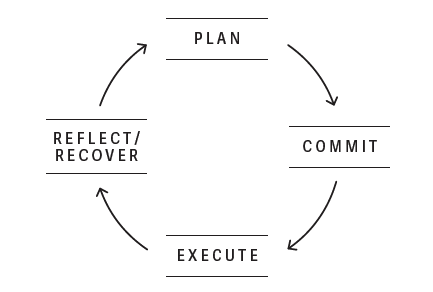
If we’re talking about in between points, pitches, or golf shots, you plan for your shot, you commit to the shot, you execute the shot, you have post-execution reflection and recovery, and then you experience sort of a flushing mechanism of whatever happened last. This serves as a routine for managing your internal environment. Within each of these steps, you might also have a routine.
Let’s say you’re a golfer. What is the routine that helps you gather the requisite information in a deliberate fashion? What is the routine to get yourself to establish commitment pre-execution? For the reflection and recovery, your routine might look like this, as an example:
Immediately post-execution, I have my human reaction.
Then I ask, What did I learn from that?
Next, I think about how to translate that into something tactical that I can bring to the planning of the next shot.
All of this factors into your routine in between shots or points. Every step of the way, you are bringing your attention to the most productive thing at the most productive time. Having a systematic approach for the downtime in between moments of execution can be incredibly valuable to help keep you on track and internally stabilized.

Explore One Day Better
In One Day Better, acclaimed mental performance coach Jeff Troesch shares sports psychology concepts he gained over 35 years of coaching professional athletes in the world’s most popular and high-pressure sports including the NFL, MLB, NBA, NHL, MLS, golf, tennis, triathlon, and NCAA collegiate sports programs.