

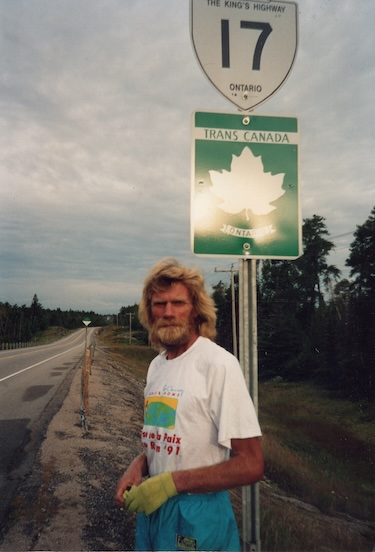
Excerpt of Chapter 16, Mile Zero, from In Search of Al Howie by Jared Beasley. Al Howie was one of the world’s first ultrarunners, taking on insane thousand-mile runs in split shorts and tank tops, fueled by beer and his own personal demons.
The TransCanada Run is a point-to-point run from one end of the TransCanada Highway in Newfoundland (Mile 1) to the other end in British Columbia (Mile 4,510). The route ascends more than 47,000 meters. Only a few people are known to have completed it, including Al Howie, who set a fastest known time that stood for 30 years. But before Howie’s world record run, there were others.
Like Steve Fonyo. Fonyo lost a leg to cancer but still managed to run the TransCanada, raising money for cancer research over a 400-day “Journey for Lives”.
If you visited the TransCanada Run’s western terminus in 1991, you would have seen only one memorial marker standing witness at Mile Zero, Victoria, Canada, to the bravery of a trans-Canada run. A small plaque holds the earth like a gravestone directly beneath the Mile Zero marker, and it is dedicated to Steve Fonyo. While Terry Fox had lost his right leg to cancer, Fonyo had lost his left. Instantly criticized for copying Fox, Fonyo, who was not an athlete, started in Newfoundland at a much slower clip than Fox’s marathon a day, sometimes running just a few miles a day. It wasn’t until he passed Thunder Bay, where Fox had been forced to stop, that the Canadian media began to take him seriously. And when Fonyo reached the Pacific Ocean after more than a year on the road, he became big news, raising $13 million for cancer research.
Fonyo became a national treasure—for a time…
Ultimately, Steve Fonyo was not Terry Fox. “If I say I feel I was chosen to do this, would you think I’m crazy?” Fonyo asked in his 2015 documentary, Hurt.
“The run really gave him an addiction for the attention,” his mother claims, in an attempt to explain the incredible downfall of Fonyo that began soon after the run. Numerous breaks with the law, drug addiction, and domestic violence marred the reputation of the once-lauded runner.
But there were others, largely forgotten, who dared to cross the Rubicon of the trans-Canada.
Mark Kent
In 1971, Mark Kent was the first person to run across Canada for speed. Unlike the hopeful amateurs who would one day follow, Mark was an athlete on the path to becoming an Olympian. A 17-year-old track star, he scored a powerful 77 on a pre-run oxygen-uptake test, just four points under Jim Ryun and 7 under dope-infused Lance Armstrong. He ran with the wind, from west to east, and finished in 125 days. He ripped through 14 pairs of Adidas, 181 packs of Tang, 791 oranges, 2,000 vitamin pills, and over 100 pounds of steak.
His run should have been a stark warning to anyone who followed; he actually considered smashing a rock on his foot and making it look like an injury, just so he could drop out and stop running. But too many people were counting on him, so he kept the insanity up for over four million steps. After the trek, he gave up on the Olympics and quit running altogether.
David Proctor Sets a New FKT
In 2018, Canadian 24-hour, 48-hour, and 72-hour record holder David Proctor attempted to break the speed record across Canada. He had talent, passion, and a mission. His son had been born with a rare disease, and Proctor hoped his run would raise a million dollars to help others with rare diseases. He started off like gangbusters, knocking off over 80 miles the first day and over 70 the second. He took a hit in the mountains of British Columbia but bounced back and fought valiantly, running several successive 68-mile days. Then the wheels came off and back pain kept him in his trailer for two days. He pushed into Winnipeg but stopped his run after just 28 days. The last day he only managed eight miles.
“One more day and I would have been hospitalized,” he told Canadian Running magazine. CBC Sports called it “Mission Impossible.”
Dan Lowndes: A Time Unconfirmed
In 1991 the formal record stood at 112 days for running across Canada, but there was also a dubious claim by Dan Lowndes. In 1979, he purported to have run from Vancouver to Halifax in 82 days. Not only was there scant documentation, but he had left out Newfoundland, Prince Edward Island, and Vancouver Island. Nevertheless, Al Howie took this as the mark to beat.
And Now, Al Howie
He planned to start in the summer of 1991, and whereas most would taper beforehand, Al did the opposite. Before the run, he won the Sri Chinmoy seven-day with 530 miles, and the Sri Chinmoy 1,000-miler in 13 days, 9 hours, and 19 minutes—almost two whole days ahead of the second-place runner. He then went back to Arizona for the Across the Years 72-hour race. He won easily with 255 miles—no need to press. He also ran the 24-hour in Victoria in the spring, won it with 128 miles, and kept racing right up until the start of his record attempt across Canada.
One week before the start, ten pairs of Brooks Kona arrived in the mail. They were exactly to Al’s specifications—the lightest pair the company put out, a mere eight ounces, and with zero arch support. Al aimed to run 450 miles a week in a racing flat/triathlon racer hybrid. He was so proud of the shoe sponsorship that despite having run in every type of shoe made for running, and many that weren’t, he would later say that all he ever ran in were the Kona.
Jesse Riley had agreed to be his handler, so they met up in Syracuse and stopped in Rochester for the Strong Arm 24-hour race. People camped on the AstroTurf infield, and some runners putted on the turf during the night. Tom Rogozinski was in the lineup and Don McNally was the race director. Al won with an easy 123 miles. The next morning, Jesse was utterly perplexed. “Al wasn’t even sore.”
When they reached Nova Scotia, just days before the start, Howie entered another race, a 12-hour run on a 400-meter track. Al and Jesse were running behind schedule, so the organizers pushed the start back to midnight. Al won with 77 miles. As Jesse slept in the van after the race, Al was climbing all over the rocks of Peggy’s Cove, taking pictures—not the least bit fatigued.
Everywhere the two went, they got food. “Newfie suitcases,” they were called, an oversized “to go” bag that could feed three. Al consumed as much as Jesse—and kept training right up to the start. All runners taper. It’s scientifically proven to be effective, but with Al all that was nonsense. Jesse was stupefied. “He was in just phenomenal shape.”
For the first time in his career, Al had a team. His wife, Claudia, would provide a comforting, homelike environment on the trip. She could relax him. She also kept a literal finger on his pulse. She would make sure he ate well and, more importantly, slept well, as his tendency was always to dismiss sleep. Claudia felt she managed all things Al. “When you’re married to a runner, you have to run yourself, in a way.”
She had done so on many occasions and knew what it was like to crew. “She made it clear,” Jesse remembers, “she was top dog.” She managed Al, looking after him in a way that was motherly in the best and worst nuances of the phrase. She was the first to hold him back, fearing he would push himself too far. She was the organizer and stage manager of the production, and as most actors know, stage managers are often underappreciated and rarely well loved.
Jesse would help pace him, provide some good-natured humor, and keep him motivated. He tried to get along with everyone. Riley had run the most with Al and was the only runner making the trip with him. As the success of the adventure hinged on Al’s performance, Jesse was integral in making it happen. He would be his pacer, confidant, talking dummy, scout, and cattle prod to help him get up those last hills that always block a runner from the end of the day’s run. However, he soon found himself the middleman.
Al was all for breaking the record. It was about the run, the effort, the challenge of how far and how fast he could get to the ocean. Jesse was in the front seat of that canoe. Sol was in the back.
Sol Ruff was brought in to handle the business side of things. He would deal with the media and the responsibilities with the Elks Lodge, the largest benefactor of the trip. Sol, a member of the Elks, saw himself as obviously the one in charge. The Elks were bankrolling the run, and their lodges organized rest points and aid stations. They were also setting up media events. Sol represented their interests, and rightfully, he assumed he was The Man. Sol got along with no one. He refused to bow down to Claudia and he didn’t respect Jesse. He saw dollars, media opportunities, and career bonuses. For him, Claudia was a fussy director and Jesse just a day player. Al was the star, but with constraints. His reputation for being overly honest brought out the Cecil B. DeMille in Sol, and he made Howie sign a disclaimer stipulating that he wouldn’t say anything negative about the Elks on the run.
Al, with his temperament, was not up to holding the reins of the position of leader. In his mind, he was there to do the running, and everything else should be taken care of by someone else. So, three others each sought to be the one to make the run a success. That was the core setup, until Claudia added her niece, Judy Pakulak. She needed another girl along to keep her sanity.
They assembled on Signal Hill, a towering, grass-covered rock overlooking St. John’s. One can only imagine the melting pot of accents gathered on that June evening in 1991, the night before the start. The Newfoundland twang of the locals was like Captain Ahab on helium. Al’s Scottish brogue was still as thick as ever, and Jesse was as Southern as chitlins. Behind them, 50 feet of red sandstone named Cabot Tower watched over. Would it see yet another failed attempt at trans-Canada glory?
The “Screech-In”
The mayor appeared, and the “screech-in” began. The screecher-inner took the middle of the circle in a fisherman’s raincoat. “Ye must kiss da cod first, ye ol’ cock.” The ugly sod of a cod was presented before Al and the proper words spoken: “Are ye a screecher?” Al grunted, “Deed, I is,” and the fish was nudged up close to his mouth, not for eating but for kissing. Al puckered up and smooched its freeze-dried lips and gleefully downed the screech, a small, airline-sized bottle of cheap rum. He was now an honorary Newfoundlander.
In the morning, when the sun rose over the Atlantic, the first psychological test of the journey said hello: As the run stretches 5,000 miles to the west, it plays tricks with the mind to have to wind your way 320 miles due north to Springdale. You are literally running in the wrong direction.
At 45, Al was a full 25 years older than Fox when he’d dipped his foot in the Atlantic. Homage was paid. Time to do it. In an interview before he started, he spoke simply. This run would be “as close to impossible as you can get.”

Explore In Search of Al Howie
Al Howie was one of the world’s first ultrarunners, taking on insane thousand-mile runs in split shorts and tank tops, fueled by beer and his own personal demons.
Then he disappeared amidst a swirl of kidnapping allegations and an Interpol investigation.
In Search of Al Howie is the critically acclaimed story of a man who ran forever and how author Jared Beasley found him—uncovering the origins of ultramarathon and exploring the larger-than-life personalities who carry on the legacy.