


After suffering four years of the crippling effects of long COVID, lifelong runner Matt Fitzgerald is desperate to reclaim his life. Hell-bent on finishing one last race, Matt enters the Javelina Jundred, a 100-km ultramarathon. It’s a race that could just as easily kill him as provide his redemption from disease. In this excerpt from his epic memoir, Dying to Run, Fitzgerald shares part of his nightly routine, a simple vagus nerve stimulation exercise from ThriveNinety that helps him reduce his symptoms.
It’s now eight o’clock—time to wind down—which for me means time to stimulate my vagus nerve. I stand up and place my right foot directly in front of the left, heel to toe, then raise my left hand to eye level with the index finger pointing toward the ceiling and my vision focused on the second knuckle. Keeping my head still, I follow the finger with my eyes as I slide it from side to side, gripping the floor with my toes to avoid teetering. After ten passes, I reverse my feet and slide my right index finger from side to side.
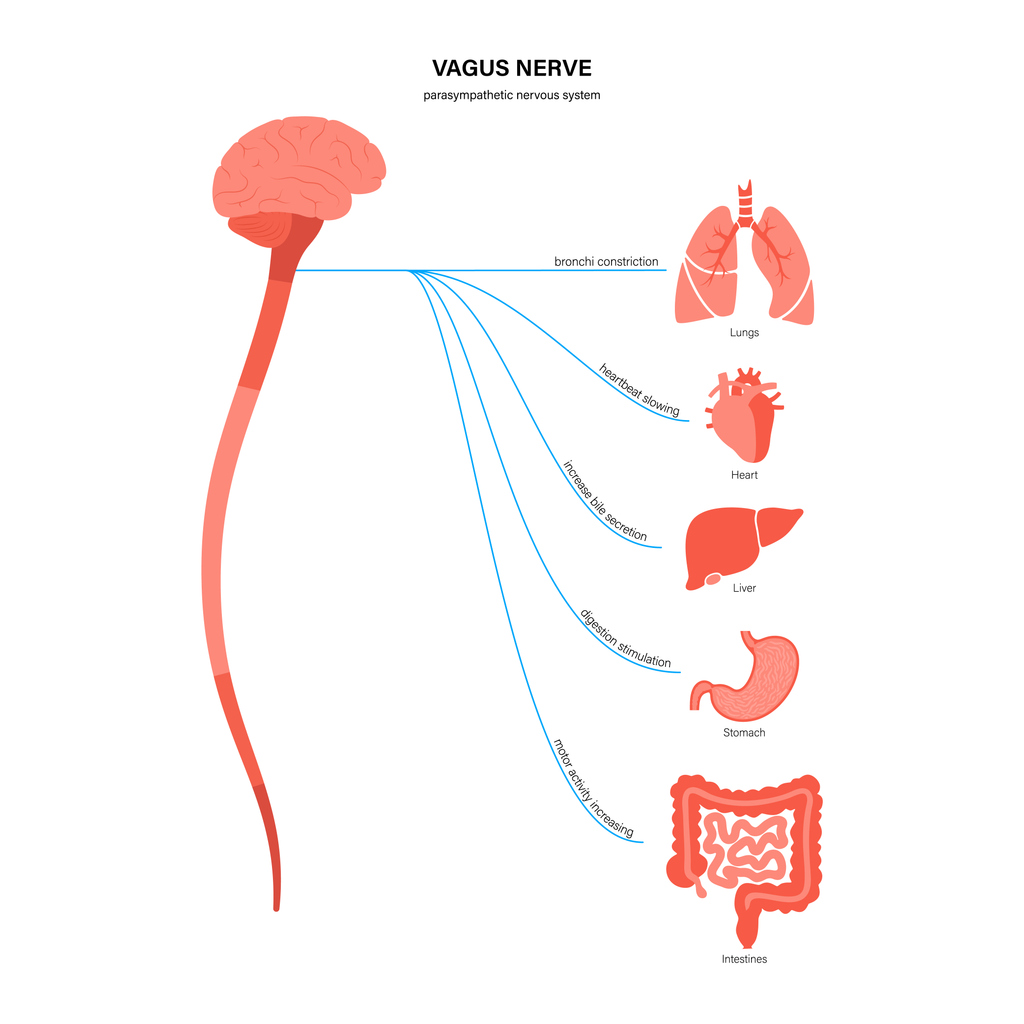
The vagus nerve is the traffic cop of the parasympathetic nervous system. It coordinates inputs from, and outputs to, a host of organs and systems and regulates a range of physiological processes that include heart rate, blood pressure, and digestion, working to ensure everything stays in sync. When the body needs to calm down and regenerate, the parasympathetic nervous system is activated and the vagus nerve hears its number called. Studies have shown that the vagus nerve is damaged and inflamed in people with long COVID, which explains a lot of our symptoms, from GI disturbances to vertigo. Exercises like the one I’m doing challenge the vagus nerve to coordinate elements of balance, eye movement, and muscle control in novel ways, and there’s evidence that frequent repetition of these exercises helps to restore vagal function. Physiology aside, they feel therapeutic, like stretching a tight muscle.
Step two in my nightly routine is progressive muscle relaxation. I lie face up on the bed, where Nataki has already made herself cozy, and tense my muscles one by one, beginning with the face and moving slowly down the body, holding each contraction for a count of ten before relaxing. Next is box breathing: inhaling four beats, holding four beats, exhaling four beats, and holding again. At home I do all of this on the Sound Lounge, an ergonomic bed with built-in speakers that vibrate when delivering the lower frequencies, massaging the user with sound waves. There’s no science behind vibroacoustic therapy, as it’s called, but everyone who tries it says the same thing afterward—“Whoa!”—which is science enough.
The source of my nightly routine is ThriveNinety, a long COVID recovery program created by Katie Brennan, a long-hauler, and Andrea Henkel, an Olympic gold medalist from Germany in the sport of biathlon, which challenges the vagus nerve like nothing else, requiring competitors to quiet their bodies enough to shoot bullseyes with a rifle between segments of high-intensity cross-country ski racing. Katie got COVID around the same time I did. Her case was mild, but no sooner had her cough gone away than she was hit with a barrage of new symptoms including pupil dilation, tachycardia, headaches, hot flashes, sleep disruption, breathing difficulty, and brain fog. A data scientist by training, Katie scoured the peer-reviewed research journals for solutions to her suffering, and to her surprise she found them not in drugs or medical procedures but in simple self-administered methods like the ones in my nightly routine.
Ask a scientist or doctor, “What is long COVID?” and you’ll get a different answer depending on the person’s specific area of expertise. A virologist will tell you it’s viral, a rheumatologist will say it’s inflammatory, an immunologist will insist it’s autoimmune, and so on. As the Buddhists say, “A farmer points the way with a radish.” There is broad agreement, however, that long COVID is not a single disorder but a cluster of related conditions, with nervous system dysregulation being common to all forms. A well-known indicator of parasympathetic dysfunction is a drop in heart rate variability (HRV), a measure of subtle variations in the heart’s contraction rhythms. HRV rises when the nervous system is relaxed and falls under stress. As a 53-year-old male, I should see HRV scores in the 50s; my actual scores are in the teens.
Katie and Andrea believe that treatments to calm the parasympathetic nervous system offer the greatest value for the largest number of sufferers, basing this claim not only on experimental findings but also on their own experiences with ThriveNinety clients. The methods might look a bit woo-woo to some, but the effects are undeniable. Earlier this year, UCLA researchers reported that self-regulated biofeedback exercises including deep breathing and progressive muscle relaxation improved overall quality of life in a group of long-haulers.
Andrea tracked me down via email after reading about me in The New York Times, leading off with a Wikipedia-style recitation of her achievements as an athlete. “I’m only mentioning this background with the hope that you keep reading,” she confessed with disarming German frankness, “and to illustrate that I have an appreciation for what it’s like to have a desire for top-end performance while managing health issues.”
Andrea was right to soften me up with her sports resume. Long-haulers are preyed upon by opportunists selling all manner of modern-day snake oil. In 2021, The Guardian ran an article about the problem under the headline “‘What Do I Have to Lose?’ Desperate Long Covid Patients Turn to Miracle Cures.” Among those interviewed was Colin Bennett, a 33-year-old professional golfer who’d wasted more than $60,000 on useless treatments such as stem cells shipped illegally from Mexico and pumped into his veins. Naturopaths charge up to $200 for a single session of hyperbaric oxygen therapy. I myself spent six thousand on a used hyperbaric chamber and got nothing out of it. Just last week I was contacted by a long-hauler named Craig who was considering dropping $14,000 on something called the Harmonic Egg. “I’ve been feeling awful for three years,” he wrote, “and I’m willing to give most things a go.”
Folks like Colin and Craig—and me—are in a difficult spot. Trust no one and we’re likely to miss out on things that actually work. Trust the wrong people and we go broke with nothing to show for it. Winning gold medals does not alone make a person trustworthy, but to me it means something. You can’t screw around with snake oil and be the best in the world at something that a whole hell of a lot of people are trying to be good at. What’s more, Andrea offered to take me through the ThriveNinety program pro bono, so I had nothing to lose but a bit of my time.
I met with Andrea and Katie via Zoom once a week for twelve weeks. Prior to our first meeting I filled out a modified version of the DePaul Symptom Questionnaire, a diagnostic instrument developed in the 2010s by scientists at DePaul University to measure the severity of individual cases of myalgic encephalomyelitis/chronic fatigue syndrome (ME/CFS), a disease category that encompasses the full panoply of post-viral chronic illnesses characterized by persistent fatigue, including long COVID. This was Andrea and Katie’s way of holding themselves accountable as healers. By completing the questionnaire before I started ThriveNinety, again at its midpoint, and once more when I finished the program, I’d come away with empirical proof that it worked—or didn’t.
I nearly canceled our third meeting after an ambitious weekend hike left me reeling with level three malaise. During the call, Andrea taught me a German method called Life Kinetik, which combines neuromotor tasks and cognitive challenges and is like weightlifting for the vagus nerve. When Andrea spoke the words “one,” “green,” “north,” or “Toyota,” I had to march in place and tap my knee with the opposite hand. When she said a different number, color, direction, or automobile make, I had to execute a different movement pattern. I felt ridiculous doing it, but the task itself was no laughing matter, requiring intense concentration, and I messed up frequently. Only when the lesson ended and Andrea asked me how I felt did I realize my PEM had disappeared completely.
I couldn’t believe it. Nothing I’d done in 40 months with long COVID had yielded an immediate reduction in my malaise level. Not gamma wave therapy, not transcranial direct current stimulation, nothing. Around this time my baseline malaise level also began to trend downward. Instead of giving credit to ThriveNinety, however, I betrayed my biases by attributing the improvement to a new medication I’d started taking. By early June I was skipping my nightly routine more often than not, and that’s when the bottom fell out. I might not be the smartest person, but I’m smart enough to know that if the new medication couldn’t prevent the Lost Period, it wasn’t responsible for the symptom reduction that preceded it. Only when I stopped taking the pills and resumed my nightly routine did I get back on track.
At half past nine I cut the lights, crawl under the covers, and open the music app on my phone. In the Before Times, I chose an anthem for each big race. For the American River 50 Mile Endurance Run in 2016 I picked a blistering live version of Funkadelic’s “Cosmic Slop.” The following year I went with Marlon Roudette’s aptly titled “Everybody Feeling Something” for the Chicago Marathon. And in 2019 I selected 1010benja’s sing-along banger “Ultimaybe” for Ironman Santa Rosa. I’d listen to my chosen anthem daily during the lead-up to the big event—during workouts, in the car, while I wrote—often visualizing the race as the music played, a sort of Pavlovian self-conditioning that made my heart pound and my muscles twitch each time I heard the tune. For the Javelina Jundred, jowever—excuse me, however—I did not choose an anthem. Instead, it chose me.
I doubt Ben Harper had either runners or long COVID in mind when he wrote and recorded “Don’t Let Me Disappear,” but it’s as if he did. I first heard this spare and quiet ballad on a “why bother?” day when I never changed out of my pajamas. After a pleasureless dinner I spoke by phone with my friend Anne, part of my growing long-hauler network, whose latest health update was that her teeth were falling out. When the call ended I shut my eyes and bowed my head, overwhelmed by what I’d just heard and feeling the sudden weight of the whole frigging nightmare. Spotify’s weekly discovery mix had been playing in the background while Anne and I talked, and it now had my full attention, pulling me in with sounds that resonated uncannily with my emotions. Like a tuning fork for the soul, Ben Harper’s mournful guitar-picking and plaintive voice lent musical expression to the woeful state of my heart, making me feel a little less alone. Tonight the tune plays on repeat from my bedside phone as I drift asleep.
Been so long since
It felt easy
Been too long since
Anyone could reach me
It’s slipping away
Don’t let me disappear . . .
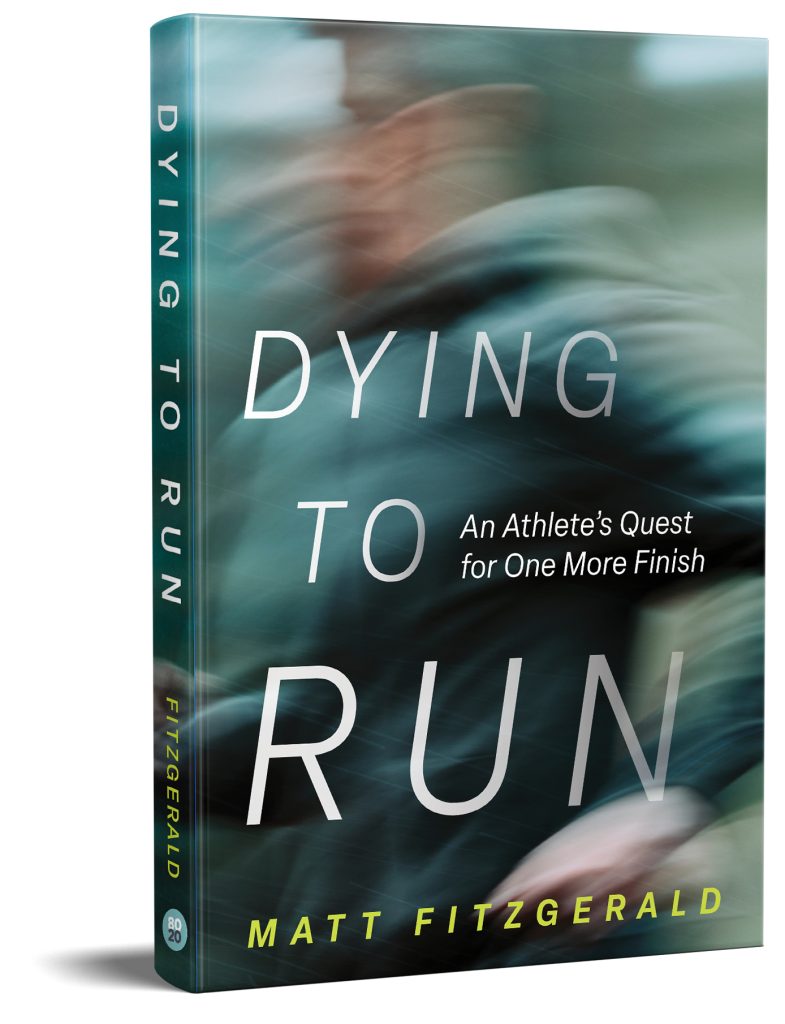
Matt Fitzgerald is Dying to Run.
What if you could race just one more time?
After four crippling years suffering from the mysterious effects of long COVID, Matt Fitzgerald is desperate to resurrect his lifelong passion for running by entering one more race, the Javelina Jundred, a 100-kilometer ultramarathon in the Sonoran Desert.
It’s a race that could kill him, but that’s a risk he’ll take to reclaim his life.
Dying to Run is a gritty race report, an epic story of adversity, and a look inside one man’s battle to live in the moment.