


After suffering four years of the crippling effects of long COVID, lifelong runner Matt Fitzgerald is desperate to reclaim his life. Hell-bent on finishing one last race, Matt enters the Javelina Jundred, a 100-km ultramarathon. In this excerpt from his epic memoir, Dying to Run, Fitzgerald shares why he entered an ultramarathon that he knew might kill him.
“What does this race mean to you?” Dhani asks.
Good question. I signed up for Javelina at midnight on New Year’s Eve, the moment registration opened. Ten months have passed since I took that fateful step, forsaking the relative safety of familiar shores for the stormy seas that have brought me here, and the reasons keep multiplying.
“Running has always been a huge part of my life,” I tell Dhani. “My dad got me into it when I was 11 years old, and I was still running at 49 when I fell sick and had to stop. I’ve coached hundreds of runners, written dozens of books about running, and turned my home into a running camp that never ends. Running is my identity, my passion, my family, my community, my church, and my career. It’s everything.”
Running is also my addiction. I worked out twice a day every day for decades before long COVID came along with other plans. I’d often go an entire month, sometimes longer, without resting. Nothing—and I do mean nothing—got in the way of my daily fix.
I once ran six miles inside an airport terminal wearing jeans and a backpack because I had an hour to kill and it was my only chance to exercise on a long day of travel.
Another time, unable to find a place to run at a crummy motel, I tromped up and down an outdoor staircase for an hour, drawing wary looks from passing riffraff.
When Nataki and I were still living in California, wildfires made outdoor exercise impossible for two weeks, so I bought an air purifier and ran on a treadmill wearing an N95 mask.
I’m the type of guy who, stuck alone in a police holding cell for two hours, will pass the time by walking in circles and doing calisthenics. I know because I’ve done it, but that’s a story for another time.
People used to praise my discipline, but runners only need discipline when they don’t want to run, and I never had that problem. I looked forward to my workouts the way schoolchildren look forward to recess. Some runs were better than others, but even the bad ones had a purpose, moving me one step closer to a goal that excited me. A writer for Runner’s World once asked me what I did to psych myself up when I lacked motivation for training. I told her I didn’t understand the question.
When I was 46, I convinced the coach of a Flagstaff-based professional running team to allow me to spend a summer training with his group of Olympic aspirants. For 13 weeks I lived like the pros, doing everything they did. I ran twice a day, got a massage every week, and worked one-on-one with a dietitian, a physical therapist, and a sports psychologist. My ambition was to write a runner’s version of Paper Lion, George Plimpton’s 1964 classic about the summer he spent training with the Detroit Lions football team as a 35-year-old journalist who’d never played a down, but the writing was really just a pretext to have the experience. If a genie had granted me one wish at this time in my life, I would have wished to spend a summer in Flagstaff living the life of an elite runner. But genies don’t exist, so I sent an email instead and my wish was granted by flesh-and-blood Ben Rosario, the aforementioned coach. Sometimes all you have to do is ask.
I’ll never forget my first run with the team, an easy eight-mile jog along sylvan trails on a sunny Monday morning in early July, when I should have been stuck behind a desk but instead was outdoors playing my favorite sport with people who played it for a living. Back at the car, I said to Nataki, who’d walked the dog while I ran, “I can’t believe I’m getting away with this!” And I never did quite believe it. For three straight months I hovered in the same state of blissful incredulity, gobsmacked by reality’s sudden resemblance to fantasy. The happiest days of my life were the 93 days when my entire life revolved around running.
Imagine having something that matters to you as much as running does to me ripped away by disease. People close to me forecasted disaster when I stopped running, but I surprised them, putting on my Stoic pants and focusing on what I could do instead of dwelling on what I couldn’t. Running itself had taught me this way of coping, which helped me through countless injuries before it helped me cope with the loss of running. Still, I grieved—at races especially, where I discovered that the pain of running a marathon is nothing compared to the pain of watching others run a marathon when you can’t.
What I needed, I decided, was an alternative finish line to chase, and I found one. More than one, in fact. Despite oftentimes being too sick to sit at a desk, much less run, I somehow managed to start a publishing company, build an apprenticeship program for aspiring coaches, and create a video-based online masterclass. None of these projects fulfilled me in quite the same way running did.
My inability to run left a running-shaped hole in my life that only running could fill.
A picture taken 15 months after I stopped running says it better than any words I could write. I was at a weekend running camp in Boulder, Colorado, where I served on a coaching staff assembled by my friend Jake (the one who wrote his dissertation on cults). It was Jake, in fact, who took the photograph, which shows me standing alone on a high school track with my hands in the pockets of my cargo shorts, looking off to the right. Not pictured are the runners themselves, who’ve just left without me. My face is expressionless, but I look bereft. And I was.
Like a lot of people with chronic illness, I anthropomorphize my disease, investing it with a willful sentience that’s antagonistic to mine. Long COVID wants to break my will by stealing my joy, and it steals my joy by stopping me from running. Tomorrow I aim to turn the tables, stealing long COVID’s joy by running farther than I ever did when I was healthy, chronic fatigue be damned, exercise intolerance notwithstanding, post-exertional malaise and all. I’m going out of my way to give the enemy inside me its best chance to break me, shoving all my chips to the center of the table despite holding a terrible hand of cards, risking everything to prove that I will never be broken. Success won’t cure me, but it might save me.
That’s what this race means to me, Dhani.
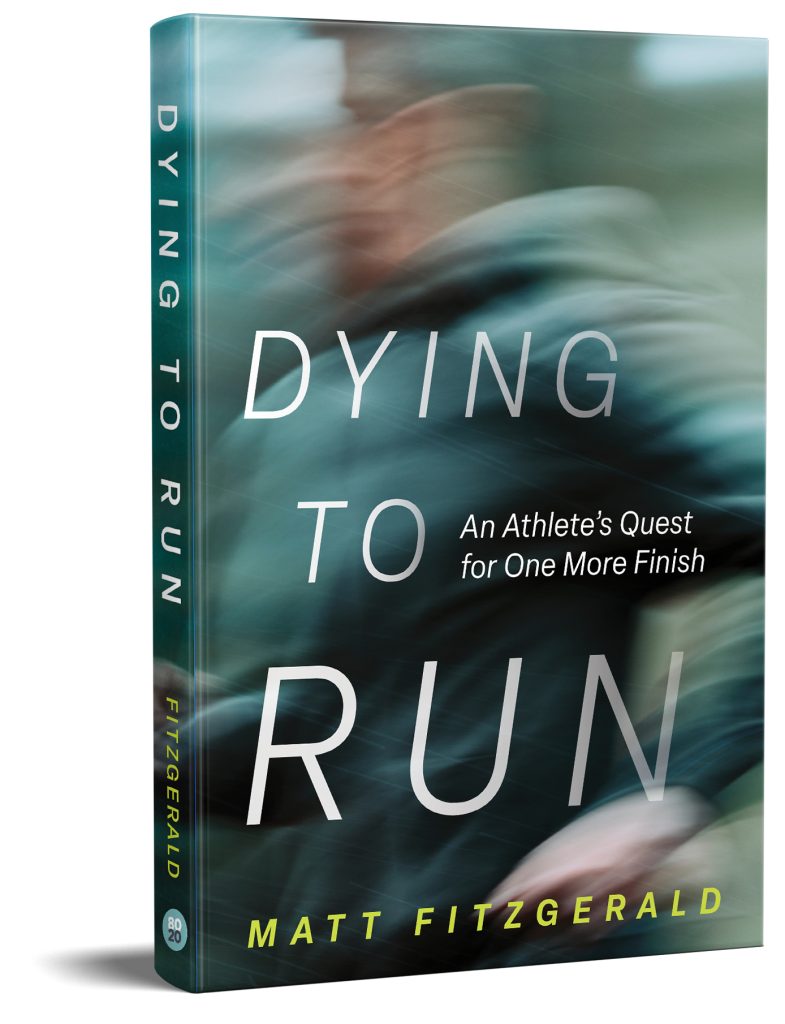
Matt Fitzgerald is Dying to Run.
What if you could race just one more time?
After four crippling years suffering from the mysterious effects of long COVID, Matt Fitzgerald is desperate to resurrect his lifelong passion for running by entering one more race, the Javelina Jundred, a 100-kilometer ultramarathon in the Sonoran Desert.
It’s a race that could kill him, but that’s a risk he’ll take to reclaim his life.
Dying to Run is a gritty race report, an epic story of adversity, and a look inside one man’s battle to live in the moment.